
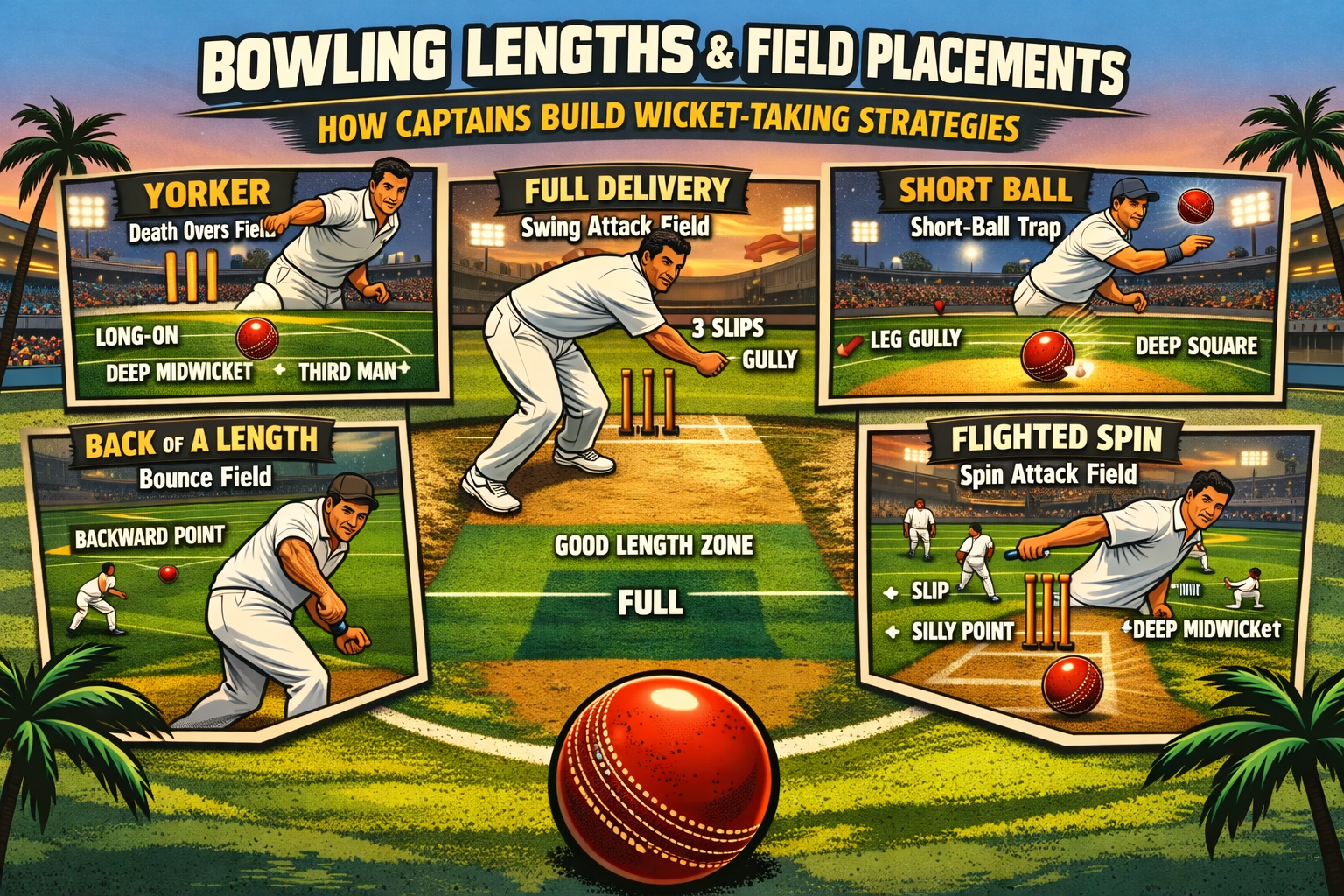
In cricket, bowling success is not only about speed or spin. One of the most important tactical elements is bowling length — where the ball lands on the pitch. Every bowling length creates different scoring opportunities and dismissal chances, which is why captains adjust field settings constantly to support the bowler’s plan.
A perfectly planned bowling length combined with the right field placement can completely control a batter’s scoring options and force mistakes.
What Is Bowling Length?
Bowling length refers to the distance from the batter where the ball pitches.
The major bowling lengths are:
- Yorker
- Full length
- Good length
- Back of a length
- Short pitch
Each length behaves differently depending on:
- Pitch conditions
- Ball condition
- Match format
- Batter technique
1. Yorker Length
Overview
A yorker lands at or near the batter’s feet. It is one of the hardest deliveries to score from when executed properly.
Yorkers are widely used:
- In death overs
- Against aggressive batters
- On flat pitches
Best Pitch Conditions
Ideal Surfaces
- Flat batting pitches
- Dry hard surfaces
- Fast limited-overs wickets
Yorkers remain effective even on pitches with little movement.
Best Bowling Types
- Fast bowlers
- Reverse swing bowlers
- Death-over specialists
Recommended Field Settings
Death Overs Yorker Field
- Long-off
- Long-on
- Deep midwicket
- Deep square leg
- Third man
- Fine leg
This setup protects boundaries while forcing low-percentage shots.
Bowling Strategy
- Attack base of stumps
- Cramp batter for room
- Mix wide yorkers with straight yorkers
2. Full-Length Delivery
Overview
A full-length ball pitches slightly shorter than a yorker and encourages drives.
This length is dangerous because:
- Batters can score boundaries
- Edges can carry to slips
Best Pitch Conditions
Ideal Surfaces
- Swing-friendly conditions
- Moist pitches
- Green tops
Full deliveries maximize swing movement.
Best Bowling Types
- Swing bowlers
- Seam bowlers
Recommended Field Settings
Swing Bowling Attack
- 3 slips
- Gully
- Point
- Mid-off
- Mid-on
- Fine leg
The goal is forcing edges through attacking drives.
Bowling Strategy
- Bowl outside off stump
- Encourage front-foot shots
- Maintain disciplined seam position
3. Good Length Ball
Overview
A good length delivery lands in the “uncertainty zone,” making the batter unsure whether to play forward or back.
This is often considered the most effective Test-match length.
Best Pitch Conditions
Ideal Surfaces
- Seaming wickets
- Hard bouncing pitches
- Slightly worn surfaces
Best Bowling Types
- Fast bowlers
- Medium pacers
- Seam bowlers
Recommended Field Settings
Traditional Test Match Field
- 2–3 slips
- Gully
- Cover
- Mid-off
- Mid-on
- Fine leg
This field supports consistent pressure.
Bowling Strategy
- Attack top of off stump
- Bowl patiently
- Force defensive mistakes
4. Back of a Length
Overview
This delivery lands shorter than a good length and rises awkwardly toward the batter.
It is especially effective on pitches with:
- Extra bounce
- Uneven carry
Best Pitch Conditions
Ideal Surfaces
- Australian-style hard pitches
- South African bouncy wickets
Best Bowling Types
- Hit-the-deck fast bowlers
- Tall seam bowlers
Recommended Field Settings
Bounce-Based Attack
- 2 slips
- Backward point
- Deep square leg
- Fine leg
- Midwicket
- Third man
This field targets hook shots and mistimed pulls.
Bowling Strategy
- Bowl into the body
- Attack rib cage area
- Mix surprise bouncers
5. Short-Pitched Delivery
Overview
A short ball rises sharply toward the batter’s chest or head.
It is mainly used:
- To intimidate
- To force mistakes
- To disrupt rhythm
Best Pitch Conditions
Ideal Surfaces
- Fast bouncy pitches
- Hard tracks with carry
Best Bowling Types
- Express fast bowlers
- Aggressive quicks
Recommended Field Settings
Short-Ball Trap
- Deep square leg
- Fine leg
- Deep backward square
- Leg gully
- Short leg occasionally
The aim is catching mistimed pull and hook shots.
Bowling Strategy
- Surprise the batter
- Alternate with fuller deliveries
- Avoid becoming predictable
How Pitch Conditions Affect Bowling Lengths
| Pitch Type | Best Bowling Length |
|---|---|
| Green Pitch | Full and good length |
| Dry Pitch | Full spin length |
| Flat Pitch | Yorkers and slower balls |
| Hard Bouncy Pitch | Back of a length and short balls |
| Cracked Surface | Good length |
| Slow Pitch | Cutters into the surface |
Field Placements for Spin Bowling Lengths
Spin bowlers also adjust fields according to length.
Flighted Full Spin Delivery
Purpose
Tempts batter into attacking shots.
Field Setup
- Slip
- Short leg
- Silly point
- Long-on
- Deep midwicket
Faster Flat Spin Delivery
Purpose
Stops batters from advancing.
Field Setup
- Deep point
- Sweeper cover
- Long-off
- Long-on
- Deep square leg
Bowling Lengths in Different Formats
Test Cricket
Preferred Lengths
- Good length
- Full attacking length
Reason
Wickets are more valuable than run prevention.
ODI Cricket
Preferred Lengths
- Back of a length
- Yorkers
- Slower-ball lengths
Reason
Containment and variation matter heavily.
T20 Cricket
Preferred Lengths
- Wide yorkers
- Hard length
- Slower short balls
Reason
Batters attack almost every delivery.
Captaincy and Bowling Partnerships
Field settings are most effective when captains understand:
- Batter strengths
- Pitch behavior
- Bowler rhythm
- Match situation
For example:
- A batter strong through covers may face packed off-side fields
- A hook-shot player may be trapped with deep leg-side fielders
- A spinner may attack rough patches with close catchers
Common Mistakes in Field Placement
1. Defensive Fields Too Early
Captains sometimes spread the field before creating pressure.
2. Wrong Boundary Protection
Protecting square boundaries while bowlers miss yorkers can backfire.
3. Ignoring Pitch Behavior
Using spin-friendly fields on seaming pitches reduces effectiveness.
How Great Bowling Attacks Use Field Plans
Top teams build entire strategies around:
- Bowling lengths
- Batter weaknesses
- Pitch conditions
- Match phases
Examples:
- Test cricket uses slip cordons aggressively
- T20 cricket uses boundary traps
- Spin attacks rely on close catchers and pressure
Conclusion
Bowling lengths and field placements are deeply connected in cricket strategy. A well-directed delivery becomes much more dangerous when supported by intelligent field settings. Fast bowlers use yorkers, short balls, and good lengths differently depending on pitch conditions, while spinners vary flight and pace to create opportunities.
Successful teams read conditions quickly, adapt their lengths smartly, and position fielders to maximize pressure. In modern cricket, tactical field placement is just as important as bowling skill itself.