
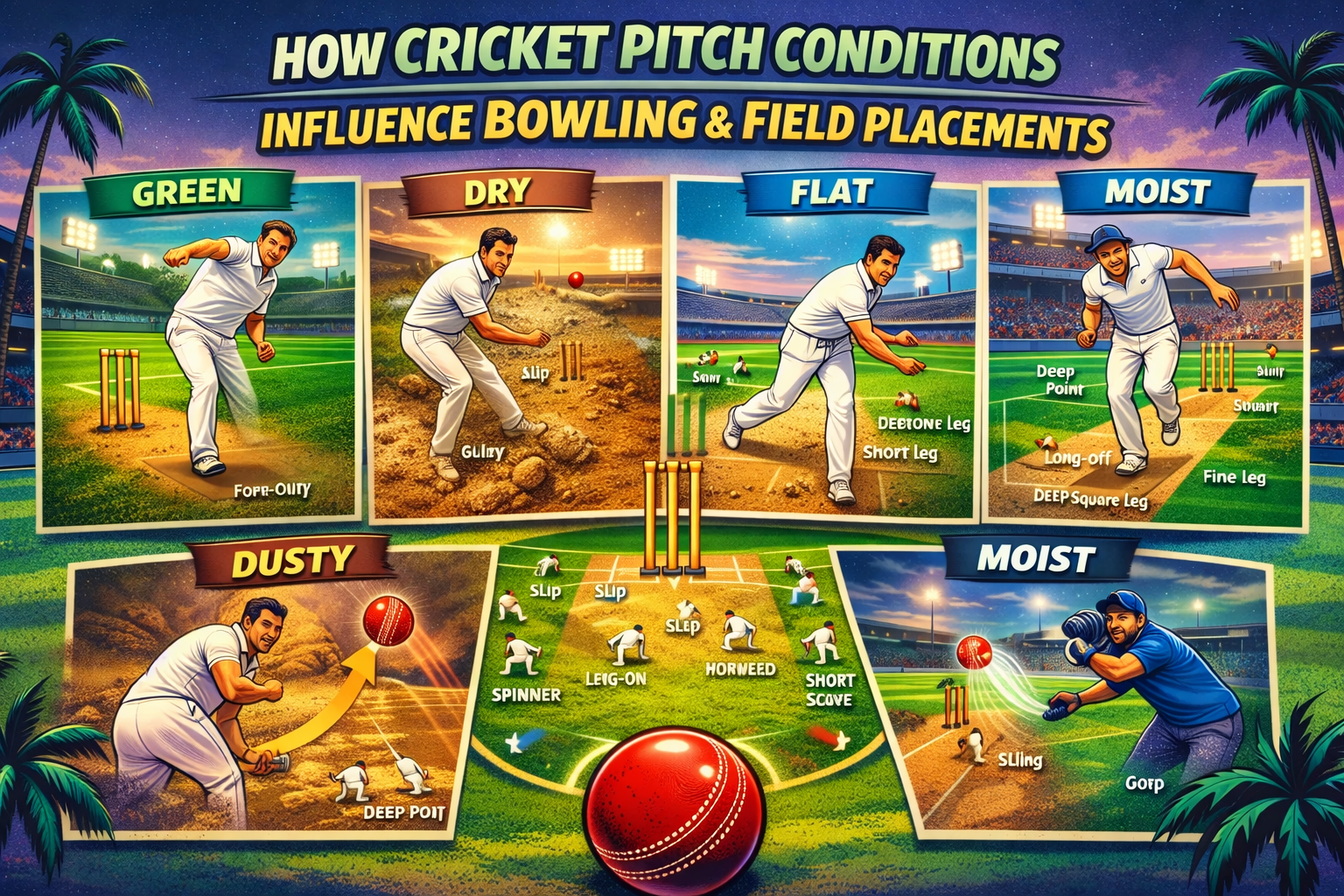
Cricket is a game heavily influenced by conditions. Among all factors, the pitch plays the biggest role in deciding how bowlers perform and how captains arrange fielders. A fast bowler on a green seaming track requires completely different tactics compared to a spinner bowling on a dry fifth-day surface.
Understanding pitch behavior and matching the correct field settings can turn an average bowling attack into a match-winning one.
What Is a Cricket Pitch?
The cricket pitch is the 22-yard strip in the center of the field where the ball is delivered. Its surface condition changes throughout a match and affects:
- Ball bounce
- Pace
- Swing
- Seam movement
- Spin
- Shot-making
No two pitches behave exactly the same.
Main Types of Cricket Pitches
1. Green Pitch
Characteristics
- Grass covering on the surface
- Moisture underneath
- Extra seam movement
- Good carry for fast bowlers
Green pitches are commonly seen in:
- England
- New Zealand
- Early morning Test matches
Best Bowling Style on Green Pitches
Ideal Bowlers
- Fast bowlers
- Seam bowlers
- Swing bowlers
The grass helps the ball move unpredictably after pitching.
Recommended Field Settings
Aggressive Seam Bowling Field
- 3 slips
- Gully
- Point
- Mid-off
- Mid-on
- Fine leg
This field attacks edges caused by seam movement.
Bowling Strategy
- Bowl fuller lengths
- Attack off stump
- Use swing early
- Maintain tight line outside off stump
2. Dry Pitch
Characteristics
- Hard surface with little moisture
- Cracks appear later
- Ball grips and turns more
Dry pitches favor spin bowling as the game progresses.
Best Bowling Style on Dry Pitches
Ideal Bowlers
- Off spinners
- Leg spinners
- Left-arm orthodox spinners
Recommended Field Settings
Spin Attacking Field
- Slip
- Short leg
- Silly point
- Midwicket
- Deep square leg
- Long-on
Close catchers pressure batters into mistakes.
Bowling Strategy
- Use flight and drift
- Target rough patches
- Vary pace
- Force batters to defend
3. Flat Batting Pitch
Characteristics
- Very little movement
- Consistent bounce
- Easy for batting
- High-scoring games
Flat pitches are common in:
- Limited-overs cricket
- Subcontinent batting tracks
Best Bowling Style on Flat Pitches
Ideal Bowlers
- Accurate medium pacers
- Variation bowlers
- Defensive spinners
Pure pace alone is often ineffective.
Recommended Field Settings
Defensive ODI/T20 Field
- Deep point
- Long-off
- Long-on
- Deep square leg
- Third man
- Fine leg
The goal is controlling boundaries.
Bowling Strategy
- Use slower balls
- Bowl yorkers
- Change angles
- Avoid predictable lengths
4. Dusty Turning Pitch
Characteristics
- Loose top layer
- Significant spin
- Uneven bounce later in match
These pitches become dangerous for batters against quality spin.
Best Bowling Style
Ideal Bowlers
- Leg spinners
- Left-arm spinners
- Finger spinners
Recommended Field Settings
Close-Catcher Spin Field
- Slip
- Leg slip
- Silly point
- Short leg
- Deep midwicket
- Long-off
Captains attack aggressively because spin creates chances constantly.
Bowling Strategy
- Bowl slower through the air
- Encourage big shots
- Exploit footmarks
- Mix spin variations
5. Hard and Bouncy Pitch
Characteristics
- Extra bounce
- Fast pace
- Ball comes nicely onto bat
Seen frequently in:
- Australia
- South Africa
Best Bowling Style
Ideal Bowlers
- Fast bowlers
- Hit-the-deck seamers
Recommended Field Settings
Short-Ball Attack Field
- 2 slips
- Deep square leg
- Fine leg
- Third man
- Backward point
- Midwicket
Designed for catches from hooks and pull shots.
Bowling Strategy
- Bowl back of a length
- Use bouncers strategically
- Attack upper body
- Keep pressure with pace
6. Damp or Moist Pitch
Characteristics
- Slower movement
- Unpredictable seam
- Ball may stop slightly
Moist pitches are difficult early but improve for batting later.
Best Bowling Style
Ideal Bowlers
- Swing bowlers
- Seam bowlers
- Medium pacers
Recommended Field Settings
Early-Morning Swing Field
- 3 slips
- Gully
- Short cover
- Mid-off
- Mid-on
- Fine leg
Attacking positions maximize wicket chances.
Bowling Strategy
- Swing the ball both ways
- Pitch fuller
- Force drives
- Maintain patience
How Field Settings Change by Match Format
Test Cricket
Characteristics
- Attacking captaincy
- Patience-based bowling
- Multiple catchers
Common Fields
- 3–4 slips
- Silly point
- Short leg
- Bat-pad
Wickets matter more than economy rate.
ODI Cricket
Characteristics
- Balance between wickets and run control
- Middle-over containment
Common Fields
- Deep cover
- Long-on/off
- Sweeper cover
- Third man
Captains rotate fields frequently.
T20 Cricket
Characteristics
- Boundary protection
- Aggressive batting pressure
- Variation bowling essential
Common Fields
- Deep midwicket
- Long-off
- Long-on
- Deep square leg
- Deep point
Bowling plans focus on limiting sixes.
The Relationship Between Bowlers and Captains
A captain’s field placement can make or break a bowler’s spell.
Good captains:
- Understand pitch behavior quickly
- Adjust fields every over
- Set traps for specific batters
- Support bowlers’ strengths
For example:
- A swing bowler needs slips
- A leg spinner may need deep midwicket and slip together
- A death bowler needs boundary riders
Common Bowling Traps Using Field Settings
| Bowling Plan | Field Trap |
|---|---|
| Outswing | Multiple slips and gully |
| Short-ball attack | Deep square leg and fine leg |
| Leg-spin temptation | Deep midwicket with slip |
| Yorker attack | Straight fielders inside circle |
| Slower-ball deception | Long-on and deep cover |
Why Pitch Reading Is Important
Teams analyze pitches before matches because conditions determine:
- Team selection
- Bowling combinations
- Batting approach
- Toss decisions
A wrong reading of conditions can lose matches quickly.
Conclusion
Pitch conditions are at the heart of cricket tactics. Green pitches favor fast bowlers and attacking slip fields, while dry turning tracks help spinners dominate with close catchers around the bat. Flat pitches demand defensive strategies and variation bowling, especially in white-ball cricket.
The best teams succeed because they:
- Adapt to conditions quickly
- Use the correct bowling attack
- Set intelligent fields
- Understand how pitches change over time
In cricket, bowling and field placement are never separate — they work together as one tactical system.