
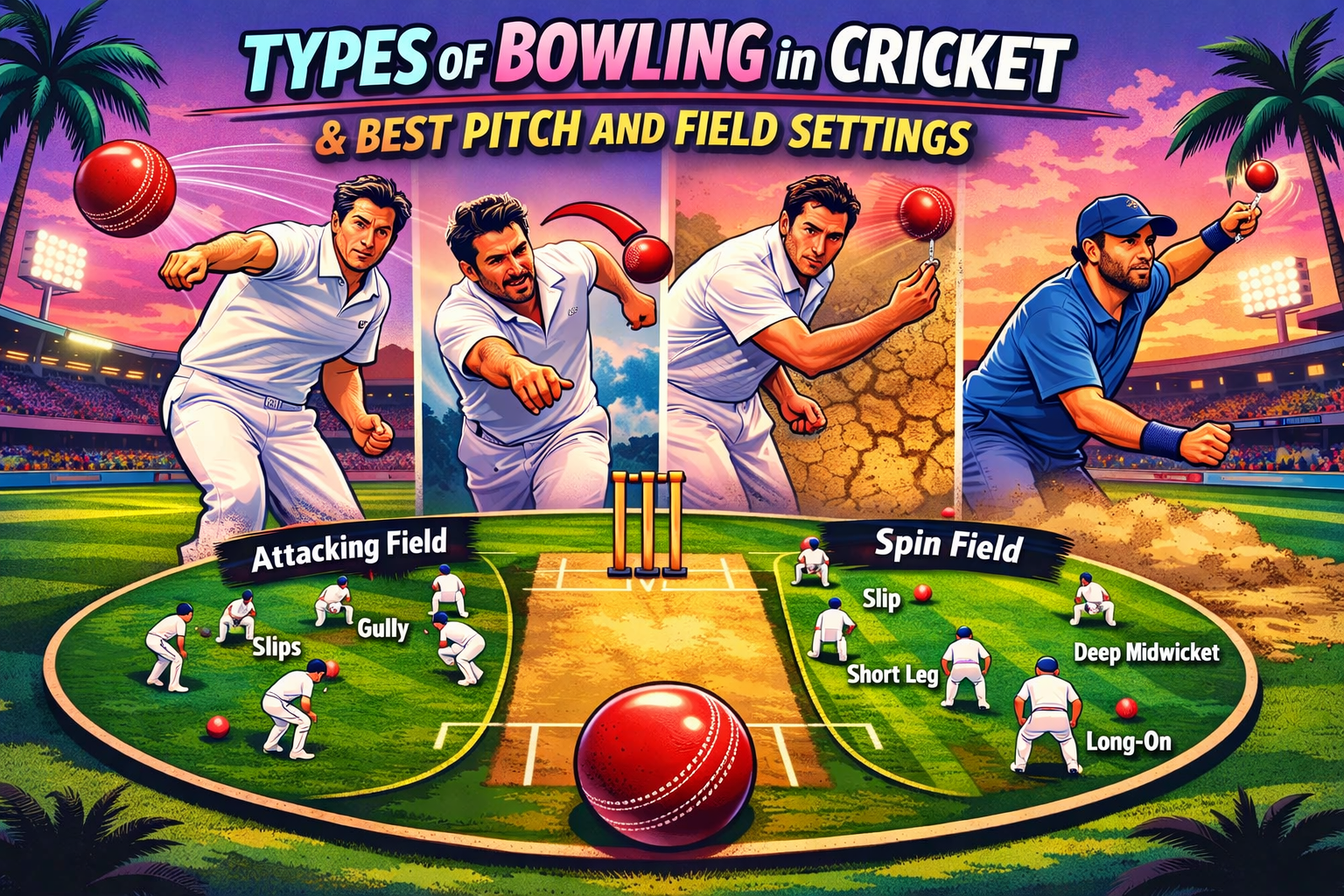
Bowling is one of the most tactical parts of cricket. Every bowling style uses different skills, speeds, and methods to dismiss batters. Conditions such as pitch behavior, weather, and field placement can greatly affect a bowler’s success. Understanding how each bowling type works — and what pitch and field settings suit it best — is essential for players, captains, and fans.
1. Fast Bowling
Overview
Fast bowlers rely on pace, bounce, swing, seam movement, and aggression. They usually bowl above 135 km/h and try to pressure batters with speed and hostile deliveries.
Main Variations
- Swing bowling
- Seam bowling
- Reverse swing
- Bouncers
- Yorkers
Ideal Pitch Conditions
Best Suited Pitches
- Green pitches with grass
- Hard surfaces with good bounce
- Moist pitches early in matches
These pitches help the ball seam and swing, making life difficult for batters.
Less Effective On
- Dry, flat pitches with little grass
- Slow turning tracks
Typical Field Settings
Attacking Field (New Ball)
Used when trying to take wickets early.
- 2–3 slips
- Gully
- Point
- Cover
- Mid-off
- Mid-on
- Fine leg
- Third man
This setup targets edges caused by swing or seam movement.
Defensive Field (Older Ball)
Used when protecting runs.
- Deep square leg
- Deep point
- Third man
- Fine leg
- Long-on/off depending on format
2. Medium Pace Bowling
Overview
Medium pacers bowl slower than fast bowlers but depend heavily on:
- Accuracy
- Movement off the pitch
- Variations
- Clever changes of pace
They are especially useful in limited-overs cricket.
Ideal Pitch Conditions
Best Suited Pitches
- Slightly damp pitches
- Slow surfaces with grip
- Overcast conditions
Medium pacers become dangerous when the ball grips or swings slightly.
Less Effective On
- Extremely flat batting tracks
Typical Field Settings
Containment Field
- 1 slip
- Point
- Extra cover
- Mid-off
- Mid-on
- Square leg
- Fine leg
- Third man
- Deep cover
The goal is to force mistakes through tight lines.
Variation-Based T20 Field
For slower balls and cutters:
- Long-off
- Long-on
- Deep midwicket
- Deep square leg
- Third man
- Deep point
3. Swing Bowling
Overview
Swing bowlers move the ball through the air using seam position and conditions. Swing can be:
- Conventional swing
- Reverse swing
Swing bowling is deadly with a new ball or old rough ball.
Ideal Pitch Conditions
Best Suited Conditions
- Humid weather
- Cloud cover
- Cool temperatures
- Slight grass on pitch
Swing depends more on atmosphere than extreme pitch turn.
Typical Field Settings
Outswing to Right-Hander
- 2–3 slips
- Gully
- Point
- Cover
- Mid-off
- Mid-on
- Fine leg
Edges often carry to slips and gully.
Inswing Attack
- Short midwicket
- Leg slip occasionally
- Mid-on up
- Square leg
Designed for LBWs and bowled dismissals.
4. Seam Bowling
Overview
Seam bowlers use the pitch surface to move the ball sideways after it lands. Unlike swing, seam movement happens off the pitch.
Ideal Pitch Conditions
Best Suited Pitches
- Green tops
- Cracked surfaces
- Moist wickets
Uneven surfaces increase seam deviation.
Typical Field Settings
Standard Seam Attack
- 3 slips
- Gully
- Backward point
- Mid-off
- Mid-on
- Fine leg
Aggressive catching positions are crucial.
5. Spin Bowling
Spin bowlers rely on revolutions of the ball to create turn, bounce variation, drift, and deception.
There are two major categories:
- Finger spin
- Wrist spin
5A. Off Spin
Overview
An off spinner turns the ball from off side to leg side against a right-handed batter.
Key Weapons
- Flight
- Drift
- Dip
- Arm ball
Ideal Pitch Conditions
Best Suited Pitches
- Dry pitches
- Dusty surfaces
- Cracked wickets
The rougher the pitch gets, the more assistance the spinner receives.
Typical Field Settings
Attacking Off-Spin Field
To right-handed batter:
- Slip
- Short leg
- Silly point
- Midwicket
- Cover
- Long-on/off depending on format
Close catchers pressure the batter.
Defensive Limited-Overs Field
- Deep midwicket
- Long-on
- Long-off
- Deep square leg
- Sweeper cover
5B. Leg Spin
Overview
Leg spinners turn the ball from leg to off against right-handed batters. Leg spin is harder to control but often more dangerous.
Main Variations
- Googly
- Flipper
- Top spinner
- Slider
Ideal Pitch Conditions
Best Suited Pitches
- Dry turning pitches
- Rough footmarks
- Fifth-day Test surfaces
Leg spinners become increasingly dangerous later in matches.
Typical Field Settings
Attacking Leg-Spin Field
- Slip
- Leg slip occasionally
- Short leg
- Silly point
- Deep midwicket
- Long-on
Leg spinners attack both edges and mistimed lofted shots.
T20 Leg-Spin Field
- Deep midwicket
- Long-on
- Long-off
- Deep cover
- Deep square leg
Captains often use leg spinners as wicket-taking options in middle overs.
5C. Left-Arm Orthodox Spin
Overview
A left-arm orthodox spinner turns the ball away from right-handed batters.
Ideal Pitch Conditions
- Dry pitches
- Slow surfaces
- Worn wickets
Typical Field Settings
- Slip
- Point
- Cover
- Midwicket
- Short fine leg
- Long-on
- Deep square
This style often attacks stumps and creates pressure through accuracy.
5D. Left-Arm Wrist Spin (Chinaman)
Overview
A rare style where a left-arm bowler spins the ball like a leg spinner.
Ideal Pitch Conditions
- Dusty turning wickets
- Rough patches outside off stump
Typical Field Settings
- Slip
- Short third
- Deep midwicket
- Long-off
- Sweeper cover
Captains usually attack because this style creates uncertainty.
6. Slow Bowlers and Cutters
Overview
These bowlers use:
- Slower balls
- Off-cutters
- Leg-cutters
- Back-of-the-hand deliveries
Very common in T20 cricket.
Ideal Pitch Conditions
Best Suited Pitches
- Slow pitches
- Dry surfaces
- Two-paced wickets
Batters struggle to time the ball.
Typical Field Settings
- Long-on
- Long-off
- Deep square leg
- Deep point
- Third man
- Fine leg
The aim is to force mishits toward boundary riders.
How Pitch Conditions Affect Bowling Overall
| Pitch Type | Best Bowling Style |
|---|---|
| Green & Moist | Fast bowling, seam bowling |
| Hard & Bouncy | Fast bowling |
| Dry & Dusty | Spin bowling |
| Cracked Surface | Spin and seam |
| Flat Batting Pitch | Accurate medium pace, defensive tactics |
| Slow Two-Paced Pitch | Cutters, slower balls, spin |
How Formats Change Field Settings
Test Cricket
- More attacking fields
- Multiple slips
- Close catchers
- Bowlers hunt wickets patiently
ODI Cricket
- Balance between attack and defense
- Ring fielders important
- Boundary riders during middle overs
T20 Cricket
- Defensive boundaries common
- Variation bowling crucial
- Captains protect shorter boundaries carefully
Conclusion
Every bowling type in cricket has unique strengths and requires different strategies. Fast bowlers thrive on pace-friendly surfaces with attacking slip fields, while spinners dominate dry turning tracks with close catchers and boundary traps. Medium pacers and variation bowlers become especially effective on slow or worn pitches where deception matters more than speed.
The best captains adjust bowling plans according to:
- Pitch behavior
- Match format
- Batter weaknesses
- Weather conditions
- Ball condition
Successful cricket teams combine bowling variety with smart field placements to create pressure and take wickets consistently.